
WELCOME BONUS 200%
UP TO €1500 + 200
FREE SPINS
UP TO €1500 + 200
FREE SPINS
Home → Blackjack
Blackjack at Riviera Casino: Variants, Rules and Payouts
Side Bet Every Round: Budget Lasts 30 Rounds
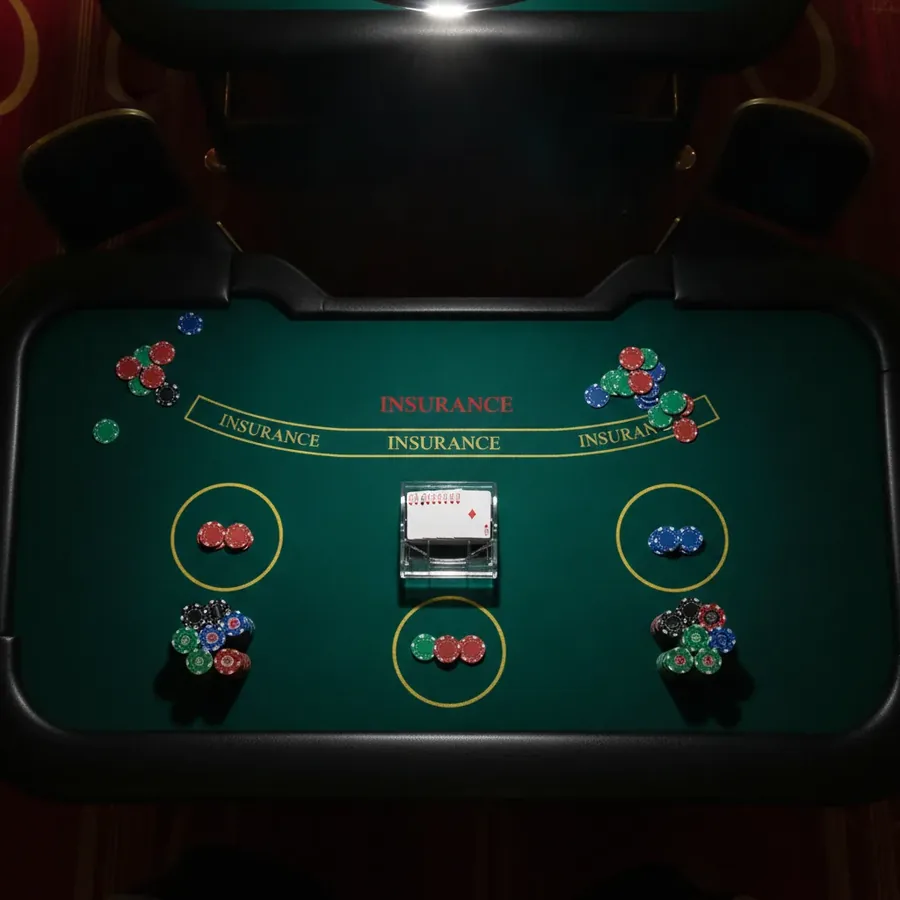
The Blackjack Insurance side bet, offered when the dealer shows an Ace, has a theoretical RTP of 92.53%, resulting in a house edge of 7.47%. This bet allows a wager up to 50% of the main bet, with a payout of 2:1. However, standard basic strategy dictates always declining this bet, unless card counting indicates a True Count of +3 or higher, where the advantage shifts.
If a player consistently places the Insurance side bet on every round without considering card counting, the higher house edge will significantly impact their budget. For a player with a budget of €300, making a €10 bet on the main hand, placing the maximum €5 Insurance bet on each of the 30 rounds would lead to an expected loss of €11.11 based on the 7.47% house edge.
This consistent use of the Insurance side bet, despite its unfavorable odds in most scenarios, can deplete a player's funds at a much faster rate. The expected loss from the Insurance bet alone over 30 rounds, assuming maximum placement each time, is €11.11, whereas a €10 bet on a game with a 0.15% house edge would only expect to lose €0.45 over the same period.
Ignored Basic Strategy Chart: 1 Percent Wasted
Playing Blackjack without adhering to the basic strategy chart can significantly increase the house edge. For example, a standard game with 6 decks, S17, DAS, DOA, and a 3:2 payout typically has a house advantage of 0.46%. However, deviating from basic strategy can add substantial percentage points to this.
The Blackjack Auszahlung 6:5 statt 3:2 variation directly impacts the player's return, changing the payout from 3:2 to 6:5. This specific rule change increases the house edge by 1.39 percentage points, a greater increase than most other rule modifications. For a €10 bet, a Blackjack pays €12 instead of €15, a noticeable difference over time.
If a player consistently ignores basic strategy and encounters rules like the 6:5 payout, their effective RTP can drop significantly, potentially by over 1 percent compared to optimal play. This means that for every €100 wagered, a player might expect to lose an additional €1.39 due to this single rule, on top of any losses from poor strategic decisions.
Live Table vs RNG Table: Speed and Limits
Live Blackjack tables, such as those provided by Evolution, offer a dynamic gaming environment with varying bet limits. Lightning Blackjack, for instance, allows bets from €1 up to €2,500, featuring multipliers up to 25x on winning hands, alongside unlimited player capacity. This creates a faster-paced game with the potential for higher payouts.
In contrast, Random Number Generator (RNG) based Blackjack tables, like the Blackjack 6 Decks, S17, DAS, DOA with a 3:2 payout, operate at a predetermined speed and may have different betting structures. While these tables offer a consistent RTP of 99.54% and a house edge of 0.46%, they typically do not incorporate the multiplier features found in live variants.
The choice between live and RNG tables at Riviera Casino can influence both the speed of play and the maximum potential winnings per hand due to features like multipliers. With bet limits up to €5,000 on Infinite Blackjack and the exciting multipliers on Lightning Blackjack, live tables can offer a different strategic approach to bankroll management compared to standard RNG tables.
One Deck vs Eight Decks in House Edge
The number of decks used in a Blackjack game significantly affects the house edge. A Blackjack game played with a single deck, adhering to classic rules and a 3:2 payout, boasts an impressive RTP of 99.85% and a house advantage of only 0.15%. This is considerably lower than multi-deck variations.
Comparing this to a game played with 6 to 8 decks, the house edge increases. For instance, Blackjack Insurance with 6-8 decks has an RTP of 92.53% and a house edge of 7.47%. The reduction in decks, from eight to one, provides an advantage of approximately 0.48 percentage points compared to an eight-deck game.
Therefore, opting for single-deck Blackjack variations at Riviera Casino, where available, can lead to a more favorable outcome for the player. The reduced number of decks, coupled with favorable rules like a 3:2 payout, contributes to a lower house edge, making each €10 bet potentially more rewarding over the long term.
Stand-on-17 Rule and Its Meaning for Players
The 'Dealer Stands on Soft 17' (S17) rule is a crucial factor in Blackjack strategy, impacting the dealer's final hand total. When the dealer stands on soft 17, their RTP is improved by approximately 0.22 percentage points compared to games where the dealer hits soft 17 (H17).
In Blackjack games where the dealer hits soft 17 (H17), the house edge is increased by 0.22 percentage points. This means that for a game with a 0.46% house edge when S17 is in play, the edge could rise to 0.68% if H17 is implemented, affecting the overall return to player.
Players aiming for optimal play should prioritize tables with the S17 rule. For example, Blackjack 6 Decks, S17, DAS, DOA with a 3:2 payout offers an RTP of 99.54%, implying a house edge of 0.46%. Conversely, a game with H17 would inherently offer a less favorable RTP to the player.
Blackjack variants at a glance
| Variant | Payout | House edge | Rule | Bet range |
|---|---|---|---|---|
| Blackjack Ein Deck, klassische Regeln, 3:2 | 99.85% | 0.15% | Weniger Decks = niedrigerer Vorteil; ein Deck gibt ca. −0.48 Prozentpunkte gegenüber 8 Decks. Oft durch 6:5 Auszahlung kompensiert. | Blackjack 3:2, Gewinn 1:1 |
| Blackjack Split / Double / H17 – Regel-Effekte | n.a. (Regel-Modifikatoren) | H17 +0.22 Prozentpunkte; RSA −0.08 Prozentpunkte; DAS −0.14 Prozentpunkte | Dealer Hits Soft 17 verschlechtert RTP um 0.22 Prozentpunkte; Resplit Aces verbessert um 0.08 Prozentpunkte; Double After Split verbessert um ca. 0.14 Prozentpunkte; 6 Decks statt 8 – ca. 0.02 Prozentpunkte. | Double – Einsatz ×2 mit einer Karte; Split – bis 4 Hände; Ass-Split meist mit einer Karte. |
| Blackjack Auszahlung 6:5 statt 3:2 (6 Decks) | 98.15% | 1.85% | Ersatz von 3:2 durch 6:5 fügt exakt +1.39 Prozentpunkte zum Vorteil des Casinos hinzu – stärker als jede andere Regeländerung. Bei $10 Einsatz zahlt Blackjack $12 statt $15. | Blackjack 6:5, Gewinn 1:1 |
| Blackjack Liberal Vegas Strip (liberale Regeln, 3:2) | 99.72% | 0.28% | Günstigste Regelkombination: S17 + DAS + Resplit + Late Surrender. Standardabweichung 1,15 | Blackjack 3:2, Gewinn 1:1 |
| Blackjack Surrender (Late Surrender) – Regel-Effekt | n.a. (Regel-Modifikator) | −0.08 Prozentpunkte | Spieler gibt Hand nach Dealer-Blackjack-Prüfung auf, verliert die Hälfte des Einsatzes. Verbessert RTP um ca. 0.08 Prozentpunkte. Early Surrender ist wesentlich wertvoller (bis −0.6 Prozentpunkte), aber extrem selten. | Rückzahlung 50% des Einsatzes |
| Blackjack 6 Decks, S17, DAS, DOA, Auszahlung 3:2, Basisstrategie | 99.54% | 0.46% | Dealer steht auf Soft 17; Verdopplung auf jeder Zweierkarte; Verdopplung nach Split erlaubt; keine Aufgabe. Basisstrategie ist für diesen Wert zwingend | Blackjack 3:2, normaler Gewinn 1:1, Insurance 2:1 |
When does the table max bet apply?
The maximum bet limit at Riviera Casino tables can vary significantly depending on the specific game. For instance, Lightning Blackjack, offered by Evolution, has a bet range from 1 EUR up to 2,500 EUR. This upper limit applies to the main bet before any potential multipliers are factored in.
In contrast, Infinite Blackjack, also from Evolution, allows for a higher maximum bet of 5,000 EUR per hand, showcasing a tiered approach to betting limits across live dealer offerings. This substantial difference means players with larger bankrolls might prefer certain tables for higher stakes play.
Understanding these maximum bet limits is crucial for bankroll management, especially for players employing strategies that require larger wagers. The 2,500 EUR and 5,000 EUR caps are key figures for players to consider when choosing a suitable table.
Splitting costs double bet: plan budget
In Blackjack Ein Deck with classic rules, splitting hands is a strategic option that effectively doubles your bet for that round. If a player chooses to split their initial two cards, the cost of playing that hand increases to cover the new split hand as well as the original bet.
For example, if a player bets 10 EUR and decides to split a pair of Aces, their total wager for that round becomes 20 EUR (10 EUR for the original hand and 10 EUR for the new split hand). This doubling of the stake is a critical factor in budget planning for blackjack sessions.
This rule, common across many blackjack variants like Blackjack 6 Decks (S17, DAS, DOA) where splitting is permitted, means a player must be prepared for their potential exposure to double when such an opportunity arises. It's a key consideration for managing funds at tables where splitting is allowed.
Chose Wrong Table for 5 EUR Bankroll
A 5 EUR bankroll presents significant limitations when selecting a blackjack table at Riviera Casino, especially considering the bet ranges. For instance, betting 1 EUR at a table like Blackjack Party or Infinite Blackjack, which has a minimum bet of 1 EUR, would allow for only five hands.
If a player were to choose a table with a minimum bet of 10 EUR, as seen with some standard blackjack variants, a 5 EUR bankroll would be insufficient to even place a single bet. This highlights the importance of checking minimum bet requirements before joining a game.
Considering that a standard blackjack payout of 3:2 means a 1 EUR bet could yield 1.50 EUR profit, even a modest win can be quickly offset by subsequent losses if the number of playable hands is extremely limited. A 5 EUR bankroll is best suited for tables with the lowest minimum stakes.
How long do 100 EUR last at a 1 EUR table?
At a 1 EUR blackjack table, such as Blackjack Party or Infinite Blackjack, a 100 EUR bankroll theoretically allows for 100 individual bets, assuming no losses. However, the actual duration depends heavily on the game's RTP and the player's betting strategy.
With an RTP of 99.56% for Lightning Blackjack, the house edge is approximately 0.44%. This means, on average, for every 100 EUR wagered, about 0.44 EUR is retained by the casino over the long term, influencing how long funds might last in a real session.
Therefore, while 100 hands are possible mathematically with a 1 EUR bet, a player's funds could deplete faster than anticipated due to the inherent house edge and the variance of outcomes in each hand played at the table.
Live stream with three cameras and OCR
The live blackjack experience at Riviera Casino, particularly with Evolution's offerings like Lightning Blackjack, is enhanced by advanced streaming technology. These streams typically utilize multiple camera angles, often three or more, to provide a comprehensive view of the gameplay and the dealer.
Optical Character Recognition (OCR) technology plays a crucial role in these live streams by accurately reading card values and game outcomes. This ensures that the digital representation of the game on your screen precisely matches the physical cards being dealt.
This combination of multi-camera feeds and precise OCR ensures a transparent and engaging environment, allowing players to follow every detail of the game, from the shuffle of the cards to the final payouts. This technology is standard for premium live dealer platforms like Evolution.
Unlimited seats via a split dealer hand
Infinite Blackjack, a live casino offering from Evolution, provides unlimited seating for players. This arrangement is made possible by allowing an unlimited number of players to join via a split dealer hand. The game's RTP stands at 99.47%.
This continuous availability means players do not need to wait for a seat, regardless of how busy the table is. The core mechanic supporting this is the ability for the dealer's hand to be split, effectively creating more opportunities for players to join the action. This feature enhances player accessibility significantly.
The maximum bet at Infinite Blackjack is €5,000, offering a high limit for engaged players. While the base game RTP is 99.47%, the presence of four side bets means players should consider their impact on the overall return to player when placing wagers.
Splitting Eights vs Standing on 16
Blackjack Liberal Vegas Strip, with liberal rules and a 3:2 payout, has an RTP of 99.72% and a house edge of 0.28%. This specific variant allows for favourable playing conditions, including the ability to split eights. Optimal strategy dictates splitting eights against any dealer upcard.
Standing on 16 against a dealer's 10 is a common strategic error that increases the house edge. In contrast, splitting eights is a favourable move that aims to improve a weak hand into two potentially stronger ones. This strategic difference highlights the importance of understanding specific blackjack rules.
The deviation from correct strategy, such as standing on 16 versus a dealer's 10, can significantly increase the house advantage. Blackjack Liberal Vegas Strip, with its favourable rules like S17 and DAS, offers a player-friendly environment where correct strategy is paramount for achieving the 99.72% RTP.
Which rule variants does the software show?
The software offers Blackjack Liberal Vegas Strip with liberal rules and a 3:2 payout, boasting an RTP of 99.72% and a low house advantage of 0.28%. This variant features a favourable combination of rules, including S17, DAS, Resplit, and Late Surrender.
Other rule sets are present, such as Blackjack 6 Decks with S17, DAS, DOA, and a 3:2 payout, offering an RTP of 99.54% and a house edge of 0.46%. These variations demonstrate different rule impacts, such as Double After Split (DAS) reducing the house edge by approximately 0.14%.
The existence of a Blackjack Auszahlung 6:5 statt 3:2 variant highlights a less favourable rule for players, with an RTP of 98.15% and a house edge of 1.85%. This change from 3:2 to 6:5 significantly increases the casino's advantage by 1.39 percentage points.
16 vs 10 played incorrectly: most common error
Playing 16 against a dealer's 10 incorrectly is a frequent mistake for many players. In the Blackjack Liberal Vegas Strip variant, which offers a 3:2 payout and a 99.72% RTP, correct strategy dictates hitting on 16 against a dealer's 10. This mistake increases the house edge.
The consequence of this common error can be significant, leading to a higher overall house advantage for the casino. For instance, in a game with a standard house edge, such a misplay moves the player further away from the theoretical RTP. The Blackjack Insurance bet, with an RTP of 92.53%, is another example of a statistically unfavourable option.
Understanding and applying basic strategy is crucial for minimising the house edge. In Blackjack Liberal Vegas Strip, the combination of liberal rules such as S17 and DAS, alongside a 3:2 payout, aims to provide a low house advantage of 0.28%, but only when played optimally.
When can you increase your bet?
In Blackjack Liberal Vegas Strip, a player can increase their bet by doubling down on any two-card total. This option is available when the initial two cards are dealt, and the player believes their hand has a good chance of winning with one additional card. The game features a 3:2 payout and an RTP of 99.72%.
The rules for Blackjack Liberal Vegas Strip also permit doubling after a split (DAS). This means that after splitting a pair, a player can choose to double their bet on one or both of the resulting hands, provided the first two cards of each new hand total two cards. This strategic option can increase winning potential.
For Infinite Blackjack, with its RTP of 99.47%, players can increase their bet through the availability of four side bets: Any Pair, 21+3, Hot 3, and Bust It. These side bets allow for additional wagering beyond the main hand, offering different payout structures and risk profiles.
Contact
Live - online chat
Banking









Providers












riviera casino 2025